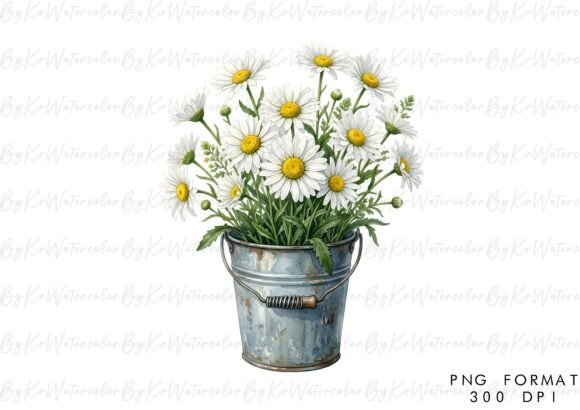
Daisies in Bucket Watercolor Clipart
Watercolor clipart remains a staple for designers and makers who prioritize organic texture, soft contrast, and visual warmth—qualities that digital vectors or flat illustrations often lack. Among recent releases, the Daisies in Bucket Watercolor Clipart stands out not just for its seasonal charm but for how thoughtfully it bridges aesthetic appeal with functional utility. This isn’t a generic floral set assembled from stock brushes; it’s a cohesive, hand-painted collection built around a single, evocative motif: fresh daisies arranged in a simple bucket. That specificity gives it quiet strength—both as a standalone element and as part of the broader Beautiful Watercolor Clipart Bundle.
A Purpose-Built Design Asset, Not Just Decoration
What makes the Daisies in Bucket Watercolor Clipart more than decorative filler is its intentional composition. The bucket grounds the arrangement—literally and visually—providing scale, context, and implied narrative. Unlike isolated flower elements that require staging, this clipart arrives pre-balanced: stems taper naturally, petals show subtle variation in opacity and edge softness, and the watercolor bleed around the bucket’s rim adds authenticity without compromising clarity. Each PNG is rendered at 300 DPI with a fully transparent background, meaning no time spent masking or refining edges in Photoshop or Procreate. For users managing tight deadlines—whether designing Mother’s Day cards for a small stationery shop or building a printable planner for Etsy—the absence of post-processing friction matters.
Consistency Without Repetition
The bundle includes multiple variations—not just alternate angles or color shifts, but thoughtful compositional variants: some with loose stems spilling over the bucket’s edge, others with tighter groupings and visible foliage. Crucially, all share the same watercolor grain, pigment saturation, and paper texture simulation. That consistency supports brand cohesion across projects. A wedding invitation suite using the daisy bucket as a header motif will visually align with matching gift tags and napkin prints—even if those assets are used months apart—because the underlying texture language remains constant. That’s rare in clipart collections where “variations” often mean recolored duplicates or minor cropping differences.
Real-World Use Cases and Workflow Integration
This clipart performs reliably across both digital and physical outputs. In digital planners, the transparency allows seamless layering over textured backgrounds or gradient overlays without haloing. For print-on-demand creators, the 300 DPI resolution holds up well on tote bags and ceramic mugs—even at larger sizes—because the watercolor grain is embedded, not simulated via filters. Sublimation users report minimal color shift when transferring to polyester blends, likely due to the intentional limitation of pigment range (soft yellows, creamy whites, muted greens) rather than oversaturated primaries that bleed unpredictably.
Scrapbookers and junk journalers appreciate the slight paper texture visible in highlights and shadows—it reads as tactile, not pixelated—and the fact that stems and leaves retain enough detail to cut cleanly with craft knives or Cricut machines. Educators integrating seasonal themes into classroom materials find the daisy motif universally approachable: it reads clearly at small sizes (e.g., stickers for behavior charts) while retaining character at poster scale.
Commercial Flexibility Without Legal Friction
The inclusion of full commercial rights—including resale of finished physical and digital products on platforms like Etsy—is a practical differentiator. Many clipart sellers restrict use in POD marketplaces or require attribution. Here, there are no such conditions. Users can embed the Daisies in Bucket Watercolor Clipart into Canva templates sold on Creative Market, print them on greeting cards distributed wholesale, or license them as part of a larger design resource pack—without seeking additional permissions. Importantly, the files arrive unwatermarked and unbranded, eliminating the need for cleanup or ethical concerns about repackaging.
Who Benefits Most—and When It Might Fall Short
This set serves creators whose work leans into natural, gentle, or nostalgic aesthetics: indie stationery brands, wellness-focused digital product designers, educators building seasonal curriculum resources, and small-batch gift shops emphasizing handmade feel. It’s especially effective for spring and early summer launches—but also works year-round in contexts where freshness, simplicity, or quiet optimism are core messaging goals (e.g., mental health journals, new baby announcements, or mindfulness workshop handouts).
It’s less suited for high-contrast branding systems, tech-forward visuals, or projects requiring bold geometric structure. If your design language relies heavily on sharp lines, neon palettes, or industrial textures, the softness of the watercolor rendering may require careful contextual balancing. Similarly, users needing botanical accuracy—distinct petal counts, species-specific leaf shapes, or scientific labeling—will find this stylized rather than taxonomic. It communicates mood and seasonality first; botanical precision second.
Long-Term Usability and File Management
The instant digital download format means no shipping delays or inventory tracking. Files are delivered as a single ZIP containing clearly labeled folders (e.g., “Daisies in Bucket – Full Composition,” “Daisies in Bucket – Stems Only,” “Daisies in Bucket – Close-Up Details”). Naming conventions follow industry standards (no spaces, underscores instead of hyphens), which helps maintain organization across cloud storage, asset management tools, or team workflows. For freelancers juggling multiple clients, that predictability reduces cognitive load during file handoffs or revisions.
One practical note: because the watercolor effect relies on subtle transparency layers, very light-colored text placed directly over clipped areas (e.g., a white quote overlaid on the bucket’s highlight) may need a faint drop shadow or subtle stroke for legibility—especially on dark backgrounds. This isn’t a flaw, but a characteristic of authentic watercolor behavior, and it’s easily addressed with standard layer effects.
Final Considerations for Practical Adoption
If you regularly create for audiences that respond to warmth, tactility, and seasonal rhythm—the kind of viewers who pause at a handmade card in a boutique or save a Pinterest pin for its gentle palette—the Daisies in Bucket Watercolor Clipart earns its place in your working library. Its value isn’t in novelty alone, but in reliability: consistent output quality, minimal setup time, and adaptability across formats. It doesn’t replace illustration skills—but it does reduce repetitive labor, letting you focus on layout, messaging, and audience resonance instead of recreating the same delicate bloom from scratch.
For teams or solopreneurs maintaining seasonal product calendars, bundling this with complementary watercolor elements—like handwritten script fonts, linen-textured backgrounds, or soft-shadowed frames—creates a repeatable visual system. And because it’s part of a larger Beautiful Watercolor Clipart Bundle, scaling usage across holidays (Easter egg motifs, Mother’s Day teacups, summer picnic blankets) becomes a matter of consistent style—not piecing together mismatched assets from disparate sources.