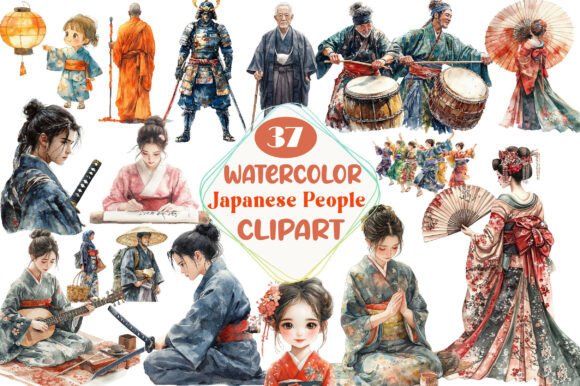
Vintage Japanese People Digital Design Collection
Imagine opening a quiet studio drawer—filled not with paper or pigment, but with 37 carefully crafted, historically resonant figures: Vintage Japanese People. These aren’t generic silhouettes or stylized caricatures. They’re authentic, respectful interpretations rooted in early-to-mid 20th-century Japanese portraiture, fashion, and daily life—rendered with intentional texture, subtle aging, and thoughtful composition. Each design carries the quiet dignity of its era: a woman in a soft-hued kimono adjusting her obi; a schoolboy in a crisp gakuran holding a satchel; an artisan seated at a low workbench, tools laid out with care. This isn’t nostalgia as decoration—it’s cultural resonance made usable.
Why These Designs Stand Out for Creators
What makes this set especially valuable is how it bridges authenticity and adaptability. The distressed effect isn’t heavy-handed grunge—it’s a light, organic grain that suggests time and tactility without obscuring detail. At 300 dpi and 12×12 inches with transparent backgrounds, each PNG scales cleanly for both print and digital use. Whether you’re printing a limited-run poster series or layering a figure into a social media graphic, clarity and flexibility are built in.
Unlike vector-only packs or over-simplified clipart, these designs retain expressive nuance: the curve of a sleeve, the tilt of a hat, the posture of someone pausing mid-step. That subtlety matters—especially when your audience includes educators developing culturally grounded lesson materials, small-batch apparel brands building narrative-driven collections, or indie publishers designing book covers with historical weight.
Real Projects, Real Applications
Here’s how creators across disciplines are already putting Vintage Japanese People to work:
- T-shirt & apparel designers use single figures as focal points on minimalist tees—pairing them with understated typography about craftsmanship, memory, or quiet resilience. One designer layered a vintage shopkeeper figure behind translucent kanji text for a “Tokyo 1938” capsule collection, selling out in 72 hours.
- Educators and curriculum developers integrate the images into slide decks, handouts, and interactive timelines—replacing stock photos with visuals that reflect real historical presence. A high school history teacher used three designs (a student, a textile worker, and a street vendor) to spark discussion on urbanization and shifting gender roles in pre-war Japan.
- DIY crafters and stationery makers print them onto kraft cardstock for handmade greeting cards, then add hand-lettered messages in English or romanized Japanese. The distressed texture pairs naturally with letterpress or foil-stamping techniques.
- Small business owners apply them to reusable tote bags, ceramic mugs, and phone cases—not as “themes,” but as quiet anchors of identity. A Kyoto-based tea shop uses a single design of a woman pouring matcha on packaging and in-store signage, reinforcing heritage without overt branding.
Adapting Thoughtfully Across Contexts
How you use Vintage Japanese People should align with your audience’s expectations—and your own values. For example:
- If designing for a global audience, pair a figure with context: a short caption explaining the garment style or historical setting (e.g., “Kimono with yūzen dyeing technique, Osaka, c. 1925”). This adds educational value while honoring specificity.
- For digital-first platforms like Instagram or Pinterest, isolate one figure per post and use clean negative space. The transparent background means you can drop it directly onto gradients, textures, or photos—no clipping masks needed.
- When adapting for print-on-demand services, test color output using a physical proof. As noted in the description, screen calibration varies—so if your project relies on precise hue relationships (e.g., matching a brand’s navy blue), order a sample before bulk production.
Maintaining Clarity and Respect
Cultural design assets carry responsibility. These files invite creativity—but not appropriation. Keep your usage grounded in appreciation, not extraction. Ask yourself: Is this figure serving a story, a function, or a deeper idea? Does it reflect lived experience—or reduce complexity to aesthetic? When in doubt, lean into simplicity: a single figure, ample breathing room, and honest context often communicate more than layered embellishment.
Consistency also matters. If you’re building a series—say, a set of seasonal greeting cards—use the same base tone (e.g., warm sepia or muted indigo) across all files. Adjust brightness or contrast uniformly in your editing software, rather than applying different filters per image. That cohesion builds trust with viewers and strengthens your visual voice.
Getting Started—Without Overcomplicating
You don’t need advanced software to begin. These PNGs open in Canva, Affinity Designer, Adobe Express, or even PowerPoint. Try this quick workflow:
- Open a new 12×12 canvas (or match your final output size).
- Drag in one Vintage Japanese People file. Resize as needed—the resolution holds up well even at 200% scale.
- Add a subtle background texture (a scanned paper grain or linen overlay) at 10–15% opacity to enhance the distressed feel.
- Include minimal, legible typography—choose fonts with modest contrast and generous letter spacing. Avoid overly decorative scripts that compete with the figure’s line work.
- Export as PNG for web or PDF/X-4 for professional print.
And remember: inspiration doesn’t require perfection on the first try. Many designers start by printing one design on plain paper, cutting it out, and arranging it physically on a mood board or product mockup. That tactile step often reveals unexpected pairings—like how a vintage schoolgirl figure balances beautifully against modern sans-serif type in a workshop flyer.
A Resource That Grows With You
This collection isn’t static—it evolves with your practice. Use one design today for a sticker sheet. Revisit it months later for a zine layout. Adapt the same figure into a watermark for your blog or newsletter. Because each file is high-resolution and transparent-background, it stays useful across formats, audiences, and goals.
Whether you’re launching a micro-brand, preparing classroom materials, or simply exploring personal expression, Vintage Japanese People offers substance—not just surface. It’s design with quiet intention. And sometimes, the most powerful creative choices are the ones that leave space—for meaning, for memory, and for what comes next.