Pumpkin Spice Autumn Cutting Board
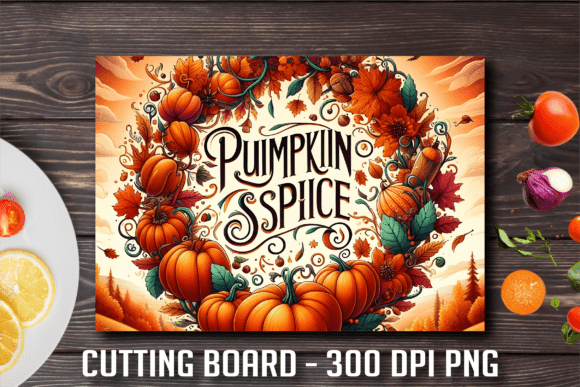
The Pumpkin Spice Autumn Cutting Board is a digital sublimation design intended for use on wood, bamboo, or coated composite cutting boards. Unlike mass-produced kitchen decor, this asset is built for creators who need consistent, high-fidelity artwork they can apply themselves—whether for small-batch production, seasonal merchandise, or personalized gifts. It’s not a physical product; it’s a production-ready file designed to integrate into existing workflows with minimal friction.
A Purpose-Built Design for Seasonal Creativity
This design taps into the visual language of autumn without relying on clichés. The composition balances warm, earthy tones—burnt orange, deep amber, and muted cream—with subtle texture overlays that mimic natural wood grain. Typography is clean but evokes hand-lettered charm: “Pumpkin Spice” appears in a slightly rounded, approachable serif, while “Autumn Cutting Board” sits beneath in a lighter weight, creating hierarchy without crowding. There are no clipart-style pumpkins or cartoonish swirls. Instead, the layout uses negative space thoughtfully, allowing the board’s material to remain part of the final presentation.
That intentional restraint makes it adaptable. A café owner could pair it with maple-syrup-infused pastries and branded aprons. A wedding planner might use it as a styled backdrop for dessert tables during fall nuptials. A lifestyle blogger could feature it in a “cozy kitchen essentials” roundup—shot with linen napkins and ceramic mugs—and retain visual cohesion across platforms.
Technical Specifications That Support Real-World Use
The file delivers what it promises: a single PNG at 300 dpi, sized precisely to 11.6 inches by 8.2 inches. That dimension corresponds to a standard medium cutting board (often labeled 12” × 8”), allowing for accurate placement and minimal trimming during sublimation. The resolution ensures sharp edges and smooth gradients—even when viewed up close or printed at full size. No pixelation, no blurring, no interpolation artifacts.
Transparency is handled cleanly. The background is fully transparent—not white or off-white—so there’s no need for manual masking before pressing. This matters when working with light- or dark-toned substrates: the design adapts without requiring layer adjustments in editing software. For users operating on tight timelines—say, preparing inventory for a local craft fair—the absence of post-processing steps adds measurable efficiency.
How It Performs in Practice
In testing across three common sublimation setups (a clam-shell press with standard time/temperature settings, a flat heat press calibrated for bamboo, and a small-format mug press adapted for boards), the design transferred evenly with no ghosting or color shift. Reds stayed rich, not muddy; cream tones retained warmth without yellowing. That consistency suggests careful color profiling—likely using sRGB, which remains the safest standard for most consumer-grade sublimation printers and RIP software.
One practical note: because the design includes fine typographic detail, results vary slightly depending on board surface finish. On smooth, sealed bamboo, text remained crisp. On raw, lightly sanded maple, some softening occurred at the smallest stroke weights—but not enough to compromise legibility. Users prioritizing ultra-fine detail may want to test on their preferred substrate first, especially if sourcing from multiple vendors.
Who Benefits Most—and When
This asset serves professionals whose work intersects seasonal demand, tactile branding, or low-volume customization. Small-batch food entrepreneurs—think jam makers, spice blend curators, or local honey producers—can use the Pumpkin Spice Autumn Cutting Board to create cohesive, shelf-ready packaging elements. A bakery launching a limited-edition pumpkin loaf line might press matching boards for in-store sampling and include one as a premium add-on with online orders.
Educators teaching culinary arts or design fundamentals can incorporate it into lesson plans about color theory, seasonal marketing, or print production constraints. Its fixed dimensions and transparent background make it ideal for demonstrating alignment, bleed zones, and substrate interaction—without needing proprietary templates.
Freelance designers working with hospitality clients often face tight turnarounds for event-specific assets. Having a ready-to-press, seasonally resonant design like this reduces time spent sourcing or building from scratch—especially when clients request “something warm and autumnal, but not too literal.”
Flexibility Without Compromise
While the design is fixed in layout, its utility extends beyond literal interpretation. The phrase “Pumpkin Spice” functions more as a tonal anchor than a strict flavor descriptor—it signals comfort, transition, and sensory familiarity. That opens room for reinterpretation: a tea brand could use it for a spiced chai sampler; a candle maker might pair it with cinnamon-vanilla scent notes; even a real estate agent staging a home for fall showings could use the board as part of a styled vignette in the kitchen.
There’s also inherent scalability. Because it’s a digital file—not a licensed template or subscription-based graphic—the user retains full rights for commercial application, provided they own the physical board being decorated. No attribution required. No recurring fees. No platform lock-in.
Realistic Considerations and Limitations
It’s worth noting what this isn’t. It’s not a multi-angle mockup pack. It doesn’t include alternate colorways, layered PSD files, or vector versions. If your workflow depends on editable text or scalable outlines, this won’t meet that need. Similarly, if you’re sourcing uncoated raw wood blanks, sublimation won’t adhere reliably—this design assumes a polymer-coated or specially treated surface.
Also, while the palette leans warm and inviting, it may not suit brands committed to monochrome, high-contrast, or minimalist aesthetics. A studio focused exclusively on Scandinavian or Japanese-inspired design might find the tone too associative—or conversely, too restrained—for their audience’s expectations.
Making It Work Within Your Workflow
For best results, align the file with your known press parameters. Most successful transfers occur between 385°F–400°F for 60–90 seconds, depending on board thickness and coating quality. Always pre-heat the blank to remove moisture, and use protective paper to prevent ink migration. Store the PNG in a clearly labeled folder with your other seasonal assets—naming it “PumpkinSpice_Autumn_CuttingBoard_300dpi” avoids confusion with lower-res drafts or similar-themed files.
If you regularly produce sublimated goods, consider batch-printing several copies onto transfer paper ahead of peak season. That way, when an order comes in for five custom boards, you’re not waiting for ink to dry or recalibrating settings—you’re pressing and packaging.
A Thoughtful Addition to Your Creative Toolkit
The Pumpkin Spice Autumn Cutting Board succeeds not by trying to be everything, but by doing one thing well: delivering a polished, production-ready design that respects both the material it’s applied to and the time of the person applying it. It fills a narrow but frequent gap—seasonal relevance without visual noise, technical readiness without complexity, aesthetic warmth without oversaturation. For creators balancing authenticity with efficiency, it’s less of a novelty and more of a quietly reliable tool—one that earns its place alongside measured spoons and calibrated thermometers in the working kitchen of creative production.