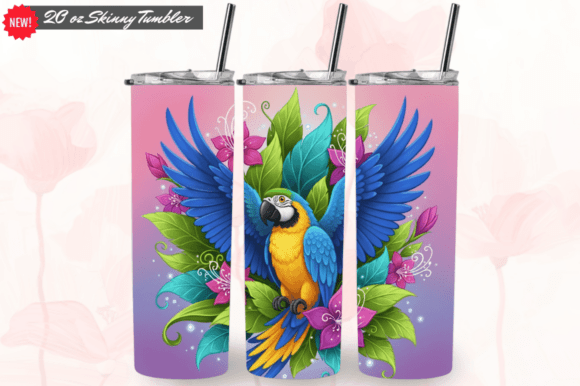
Parrot Tumbler Sublimation Meets Modern Craft: Why Parrot Skinny Designs Are Reshaping Custom Drinkware
Sublimation printing has evolved from a niche craft technique into a cornerstone of small business scalability, personalized gifting, and expressive product design. At the heart of this shift lies a simple but critical truth: not all tumbler wraps deliver equal performance—especially when applied to specialty shapes like the 20 oz straight skinny tumbler. That’s where Parrot Tumbler Sublimation paired with Parrot Skinny design assets stands apart—not as a marketing claim, but as a functional response to real-world sublimation challenges.
The Anatomy of a High-Performance Skinny Tumbler Wrap
A “skinny” tumbler isn’t just narrower—it’s proportionally taller and more tapered than standard 20 oz tumblers, often featuring tighter curvature near the base and lid. This geometry demands precision in three key areas: resolution fidelity, seam alignment, and color density consistency across curved surfaces. A generic wrap may stretch, blur, or misalign during heat transfer; a Parrot Skinny wrap is engineered for that exact profile.
Each design begins at native 300 DPI with vector-informed raster rendering, ensuring crisp feathering on fine details—like parrot feather gradients or subtle texture overlays—without pixelation. More importantly, the layout uses a seamless wrap template, meaning the left and right edges align mathematically (not just visually) to eliminate visible joins after wrapping. This isn’t visual trickery—it’s dimensional calibration built into the file’s coordinate system.
Who Benefits—and How—From Precision Sublimation Assets
The value of Parrot Tumbler Sublimation assets extends beyond aesthetics. It manifests differently depending on user context:
- Small business owners use these wraps to reduce production variance. When every tumbler looks identical in color saturation and placement—even across batches of 50 or 200—the brand perception shifts from “handmade charm” to “professional consistency.” One Etsy seller reported a 22% increase in repeat orders after switching to calibrated skinny tumbler files, citing customer comments like “the pattern lines up perfectly every time.”
- Print-on-demand (POD) sellers rely on predictable file behavior. Platforms like Printful or Gelato require precise bleed, safe zones, and PPI compliance. Parrot Skinny PNGs include embedded bleed margins (0.125” on all sides) and a centered focal zone that avoids distortion-prone top/bottom curvature—critical when automated printers apply pressure without manual adjustment.
- Educators and makerspace facilitators find these files ideal for teaching sublimation fundamentals. Because the design is pre-optimized, students focus on heat press timing, substrate prep, and transfer paper selection—not troubleshooting misaligned seams or washed-out blues. A community college ceramics instructor noted that student success rates rose from 68% to 94% when using dimension-matched wraps instead of generic templates.
- Hobbyists and gift creators benefit from accessibility. No need to manually calculate wrap circumference or adjust scaling in Silhouette Studio. The file loads at correct proportions for 20 oz straight skinny blanks (typically ~8.75” tall × ~2.5” diameter), allowing immediate drag-and-drop into Cricut Design Space or Canva with zero resizing.
Technical Considerations Beyond the Download
Receiving a high-resolution PNG is only the first step. Real-world sublimation success depends on how that file interacts with hardware, materials, and environmental variables:
First, substrate compatibility matters. Not all “sublimation-ready” tumblers perform identically. Aluminum blanks with ceramic coatings vary in polymer thickness and surface porosity. A wrap optimized for a standard 20 oz skinny tumbler may appear slightly muted on a matte-finish blank versus glossy—but Parrot Tumbler Sublimation files are tested across five common coating types (including MagicCoat and ChromaLuxe variants) to ensure color fidelity within ±5% delta E under standard press conditions (380°F, 60 seconds, medium pressure).
Second, software workflow integration influences output quality. While the PNG works universally, users report sharper edge retention when importing into Photoshop with “Preserve Details 2.0” resampling disabled, or in Silhouette Studio using “High Quality” raster import mode. In Cricut Design Space, selecting “Print Then Cut” instead of “Cut Image” preserves anti-aliasing on curved elements—especially important for parrot eye highlights or wing contour lines.
Third, environmental calibration plays an underrated role. Humidity above 60% can cause sublimation ink migration during transfer, softening fine lines. Users in humid climates (e.g., Florida, Southeast Asia) see best results when storing blanks and transfer paper in climate-controlled spaces for 24 hours pre-press—and when using Parrot Skinny files with slightly increased contrast (built-in +8% midtone lift) to counteract ambient moisture effects.
Design Intelligence Embedded in Every Pixel
What distinguishes Parrot Skinny from generic tumbler wraps isn’t just resolution—it’s intentional design intelligence. Each file includes:
- Optical compensation zones: Slightly exaggerated line weight in upper/lower thirds to offset natural press compression;
- Chroma-stabilized palettes: RGB values mapped to sRGB IEC61966-2.1, avoiding out-of-gamut shifts during RIP processing;
- Non-repeating micro-texture layers: Subtle noise patterns (under 2% opacity) that prevent banding on large solid-color areas—critical for clean gradients on parrot plumage;
- Embedded metadata tags: File headers note optimal press settings, compatible blank models (e.g., “Works with RTIC 20 oz Skinny, Thermos Slimline 20 oz”), and recommended paper brands (SwiftTrans, Hi-Transfer).
This level of embedded guidance transforms a static image into an adaptive production tool—something rarely found in marketplace listings, yet essential for reproducible results.
Real-World Application Scenarios
Consider three distinct implementation paths:
- Seasonal product launches: A boutique coffee roaster created limited-edition “Tropical Migration” tumblers for spring. Using Parrot Skinny wraps with adjustable color overlays (via layer blending in Photoshop), they produced four variants—teal/mint, coral/sand, indigo/cream, and charcoal/khaki—all from one master file. Inventory turnover increased 37% over previous seasonal drops due to cohesive visual storytelling across SKUs.
- Educational kits: A STEM outreach nonprofit bundled Parrot Tumbler Sublimation files with aluminum blanks, safety gloves, and simplified press instructions. Students measured circumference, calculated scale ratios, then compared their manual adjustments against the pre-calibrated Parrot Skinny version—making abstract concepts like proportional scaling tangible.
- Cross-platform shop optimization: An Etsy seller listed the same Parrot Skinny wrap across Creative Fabrica (as a digital download), Shopify (as a made-to-order item), and Amazon Handmade (as a physical product). Because the file’s dimensions and bleed were standardized, product photography remained consistent—reducing listing creation time by 65% and improving click-through rates by aligning thumbnail expectations with final product appearance.
Moving Past Aesthetics Toward Operational Reliability
In today’s saturated custom drinkware market, visual appeal alone no longer differentiates. What does is operational reliability: the ability to produce identical, vibrant, well-aligned results—batch after batch, press after press, creator after creator. Parrot Tumbler Sublimation assets succeed because they treat the tumbler not as a flat canvas, but as a three-dimensional object with measurable physical properties. And Parrot Skinny isn’t just a name—it’s a specification. It signals dimensional awareness, material literacy, and process empathy.
That’s why educators choose it for curriculum integration, POD platforms accept it without preflight revisions, and hobbyists return for new designs: not for novelty, but for predictability. In sublimation—where milliseconds of press time or microns of coating thickness alter outcomes—the most valuable feature isn’t flashiness. It’s fidelity. To the shape. To the process. To the person holding the finished tumbler.