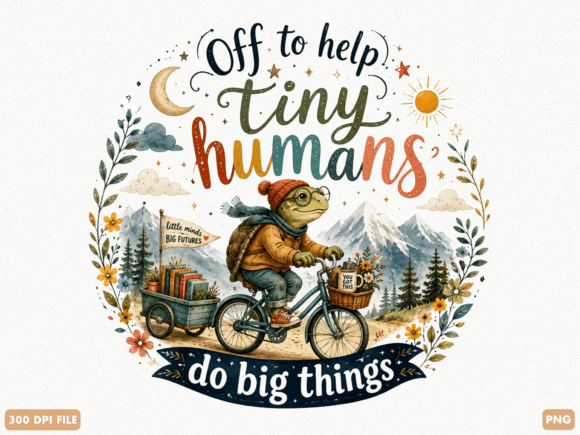
Off to Help Tiny Humans PNG
The Off to Help Tiny Humans PNG is a high-resolution digital illustration file designed for versatile creative use. It features a clean, transparent background and is delivered in RGB color mode at 300 DPI—standard for professional print and digital applications. As a single PNG file, it requires no editing software to open or place into design workflows, making it accessible for users with varying levels of technical experience.
This design centers on a lighthearted, compassionate theme—suggesting care, support, or service directed toward children. Its visual tone is warm and approachable, avoiding overt stylization that might limit adaptability. Because it lacks text or complex gradients, it scales well across product types without distortion or loss of clarity.
Why Someone Might Consider This Design
Individuals often seek ready-to-use digital assets like the Off to Help Tiny Humans PNG to streamline production—especially when launching small-batch merchandise, creating themed gifts, or building cohesive branding for child-focused services (e.g., pediatric therapy, early education, or family wellness). Its thematic resonance makes it relevant for niches such as childcare professionals, birth photographers, doula collectives, or nonprofits serving young families.
For crafters and small business owners using print-on-demand platforms, having a pre-optimized file saves time spent on background removal, color correction, or resolution adjustments. The transparent background eliminates the need for manual masking, and the 300 DPI resolution meets most platform requirements for apparel, mugs, tote bags, stickers, phone cases, pillows, and wall art.
Practical Benefits and Realistic Expectations
One key benefit is flexibility: because the file is a static PNG—not layered PSD or vector SVG—it can be imported directly into common tools like Canva, Cricut Design Space, Adobe Photoshop, or Silhouette Studio without conversion steps. Its RGB color mode ensures accurate on-screen previews, though users preparing for CMYK printing should verify color fidelity with their printer or service provider.
However, this format has inherent tradeoffs. A PNG cannot be scaled infinitely without pixelation; while 300 DPI supports standard product sizes (e.g., 12×16″ wall art or full-front shirt prints), enlarging beyond ~24 inches may reveal softness. Additionally, the fixed composition means no built-in variants—no alternate poses, color swaps, or layout options. Users needing customization must edit the file themselves or hire a designer.
Commercial use rights are included, which matters for sellers on Etsy, Redbubble, or Amazon Merch. Still, buyers should review the license terms carefully: while resale of physical items bearing the design is permitted, redistribution of the PNG itself—or claiming authorship—is prohibited. This aligns with industry-standard extended licenses but differs from royalty-free stock models that allow broader reuse.
When This Design Is a Strong Fit
The Off to Help Tiny Humans PNG works best when the project’s goals match its attributes: simplicity, thematic clarity, and production efficiency. For example:
- A doula creating custom “Welcome to the World” onesies for client welcome kits.
- A preschool teacher designing classroom posters or parent handouts about empathy and caregiving.
- A small-batch ceramicist applying the image to mugs or coasters for a boutique launch tied to childhood development themes.
- A freelance designer sourcing a central motif for a client’s rebrand focused on pediatric occupational therapy.
In each case, the design serves as a functional, emotionally resonant element—not a standalone artwork. Its strength lies in supporting a message rather than demanding attention through complexity.
When Alternatives May Be Worth Considering
If your use case requires scalability across vastly different formats—such as embroidery digitizing, large-format vinyl signage, or responsive web graphics—a vector-based alternative (e.g., SVG or EPS) would offer sharper results at any size. Similarly, if you need multiple stylistic versions (e.g., line art only, color-filled, or monochrome), a layered source file or custom commission may better suit long-term needs.
For users prioritizing uniqueness, it’s worth noting that widely distributed digital designs carry a risk of repetition—especially on mass-market platforms. If brand distinction is critical (e.g., for an established children’s apparel line), pairing this asset with original typography, complementary illustrations, or photo integration helps differentiate output.
Also consider workflow compatibility: if your production pipeline relies heavily on AI-assisted tools for mockup generation or batch resizing, ensure the PNG imports cleanly. Some generative tools handle transparent PNGs inconsistently, particularly with anti-aliased edges. Testing with a sample file before bulk deployment is advisable.
Making an Informed Decision
To determine whether the Off to Help Tiny Humans PNG fits your needs, ask three questions:
- What products or materials will I apply it to? If those fall within common sublimation, DTG, or sticker parameters—and don’t exceed ~20″ in longest dimension—the resolution and format are appropriate.
- How much control do I need over appearance? If you’re comfortable adjusting size, placement, and contrast yourself—or have access to basic editing tools—you’ll likely find the file sufficient. If you require precise Pantone matching or multi-angle views, additional resources may be needed.
- Does the theme align meaningfully with my audience or purpose? Visual relevance matters more than technical specs. A technically perfect file that feels off-brand or misaligned with your mission won’t serve long-term goals—even if it prints flawlessly.
Digital design purchases involve balancing immediacy against adaptability. The Off to Help Tiny Humans PNG leans toward immediacy: it’s ready, licensed, and technically sound for common applications. That makes it practical for time-constrained projects or users building confidence in digital production. But it doesn’t replace strategic design thinking—especially around context, audience perception, and long-term brand consistency.
Before downloading, preview how the design appears against representative backgrounds (e.g., light vs. dark fabric mockups) and confirm compatibility with your intended platform’s file guidelines. Most reputable sellers provide usage examples and technical notes—review those alongside your specific production requirements to avoid surprises during upload or printing.