Nine Question Marks in Colorful Circles: A Versatile Design Asset for Creative Problem-Solving and Visual Communication
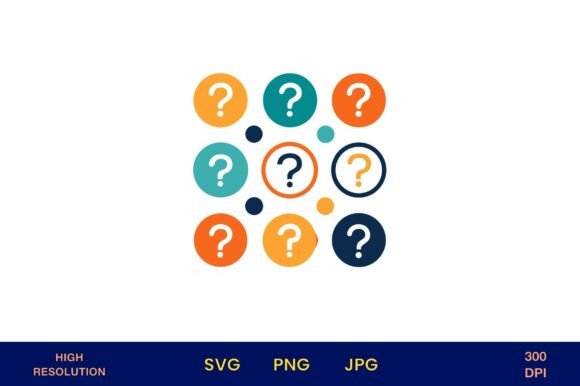
Visual metaphors shape how we process uncertainty, curiosity, and inquiry—especially in environments where clarity must coexist with playfulness. The Nine Question Marks in Colorful Circles design set embodies this balance: nine distinct, hand-crafted question marks, each enclosed within its own vibrant circular frame, rendered in high-fidelity vector form. Unlike generic clipart or overused stock icons, this collection is intentionally composed to support both aesthetic cohesion and functional flexibility across physical and digital contexts.
Why Nine? Why Circles? Why Color?
The number nine carries subtle psychological resonance—it’s the largest single-digit integer, often associated with completion, reflection, and multidimensional thinking. In design terms, nine offers enough variety to avoid repetition without overwhelming the viewer. Each question mark is uniquely styled: some lean with gentle asymmetry, others tilt upward with energetic optimism; a few feature playful serifs or rounded terminals, while others embrace minimalist geometry. This variation invites closer inspection—not as decorative noise, but as intentional visual diversity that mirrors real-world complexity.
Circles are among the most universally recognized shapes—symbolizing wholeness, inclusivity, and continuity. When paired with question marks, they soften the inherent tension of uncertainty. A question inside a circle doesn’t feel like a gap waiting to be filled; it feels like an invitation to explore, reflect, or collaborate. That shift—from deficit framing to open-ended possibility—is what makes this set especially valuable for educators designing inquiry-based lesson materials or facilitators building workshop visuals.
Color functions here not just decoratively, but semantically. The palette spans saturated teals, warm corals, sunlit yellows, deep violets, and earthy terracottas—each hue carefully calibrated for contrast and accessibility. No two adjacent circles share identical saturation or value, ensuring legibility even when scaled down or overlaid on textured backgrounds. This attention to chromatic intentionality supports inclusive design practices, whether used in classroom posters viewed by neurodiverse learners or branding assets deployed across varied screen types.
Practical Applications Across Diverse Fields
What distinguishes the Nine Question Marks in Colorful Circles set isn’t just its visual appeal—it’s its adaptability across workflows and disciplines. Below are concrete, field-tested applications demonstrating how professionals integrate these elements meaningfully:
- Educators and Curriculum Designers: Use individual circles as interactive “thinking prompts” on printable worksheets—students place one beside concepts they’re unsure about, then revisit them after research or discussion. In digital learning platforms, animate each circle to appear sequentially during Socratic questioning routines.
- UX Researchers and Product Teams: Embed the icons into journey maps or empathy maps to visually flag unresolved user needs or ambiguous pain points. Their non-threatening shape encourages stakeholders to engage with gaps rather than gloss over them.
- Wedding Planners and Stationery Designers: Leverage the set’s elegance and warmth for “Save the Date” cards where couples want to evoke anticipation—not formality. One circle becomes a custom RSVP tracker; three arranged in an arc serve as decorative dividers on seating charts.
- Small Business Branding (Florists, Photographers, Therapists): Integrate a single circle into logo lockups or social media banners to signal openness and client-centered inquiry—e.g., a floral studio using a sage-green question mark beside “How can your vision bloom?”
- Print-on-Demand Creators: Scale the 4500px × 4500px PNGs to full-bleed dimensions for mugs, tote bags, or wall art. Because each icon includes a transparent background, designers can layer them over gradients, botanical illustrations, or monochrome photography without clipping masks or manual cleanup.
Technical Strengths That Support Real-World Use
This is a digital product built for durability—not trend-chasing. Its technical specifications respond directly to production realities faced by creators at every level:
- High-resolution raster output (4500px × 4500px, 300 dpi) ensures crisp reproduction from business card size to large-format posters—no pixelation, no interpolation artifacts.
- Transparent background eliminates time-consuming background removal. Whether placing a coral question mark onto navy-blue wedding menus or overlaying a gold-toned variant onto a linen-textured planner cover, compositing is instantaneous.
- Vector-derived precision means edges remain razor-sharp at any scale. Though delivered as PNG, the underlying construction honors vector logic—curves are mathematically smooth, spacing is optically balanced, and alignment is consistent across all nine units.
- Format compatibility extends beyond standard graphic software. These files import cleanly into Canva, Adobe Express, Affinity Designer, Cricut Design Space, and even PowerPoint—making them accessible to non-designers managing community event graphics or school newsletter layouts.
Thoughtful Integration Over Decorative Sprinkling
Many design assets fail not because they’re unattractive, but because they’re applied without narrative intent. The Nine Question Marks in Colorful Circles set resists superficial use. Its strength lies in supporting communication goals—not distracting from them.
Consider a therapist developing a printable journal for adolescent clients navigating identity questions. Rather than scattering question marks randomly, they might assign specific colors to thematic clusters: blue for emotional awareness (“What am I feeling right now?”), yellow for values exploration (“What matters most when I make choices?”), and violet for future-oriented reflection (“What version of myself feels most authentic?”). This transforms decoration into scaffolding—a quiet, consistent visual language reinforcing cognitive structure.
Similarly, a university department launching a new interdisciplinary research initiative could use all nine circles as modular headers across their website—each representing a core inquiry domain (e.g., ethics, sustainability, technology, equity). Visitors don’t just see icons; they perceive architecture—an organized landscape of open questions guiding scholarly work.
Considerations for Ethical and Effective Use
Even versatile tools require mindful deployment. Here are key considerations grounded in design ethics and practical experience:
- Avoid visual overload: Using more than three circles in a single composition risks diluting focus. Prioritize hierarchy—let one dominate as a focal point, others recede as supporting elements.
- Respect cultural context: While the question mark is widely recognized in Latin-alphabet contexts, its interpretation varies globally. When designing for multilingual or international audiences, pair icons with clear text labels or test comprehension with representative users.
- Maintain typographic harmony: These circles thrive alongside clean, humanist sans-serifs (e.g., Inter, Lato, Poppins) or warm serifs (e.g., Merriweather, Cormorant Garamond). Avoid pairing with overly decorative or condensed typefaces that compete for attention.
- Accessibility first: When used in digital interfaces, ensure sufficient color contrast between question mark glyphs and surrounding UI elements. The set’s bold outlines and generous negative space already support this—but always verify with automated checkers and real-user feedback.
From Inquiry to Implementation: A Workflow Example
Imagine a small nonprofit launching a community storytelling project centered on local climate resilience. Their team needs assets that communicate openness, curiosity, and collective intelligence—not authority or finality.
They begin by selecting three circles: one in oceanic blue (representing water systems), one in forest green (ecosystems), and one in amber (energy and transition). They place these in the header of their printable story-gathering kit, each paired with a short prompt: “What has changed near the riverbanks?” / “Which trees tell the oldest stories?” / “Where do you feel heat shifting in your neighborhood?”
Later, they export the same circles at reduced opacity and tile them subtly behind interview transcripts shared online—creating texture without obscuring text. Finally, they isolate the amber circle, resize it to fit a ceramic mug, and print it alongside the phrase “What if our next idea begins with a question?”
This progression—from structured inquiry tool to ambient visual motif to branded object—demonstrates how the Nine Question Marks in Colorful Circles set enables layered, purpose-driven expression without requiring advanced design expertise.
Conclusion: Design as a Catalyst for Curiosity
In an era saturated with declarative visuals—checkmarks, arrows, trophies—the enduring power of the question mark remains quietly radical. It signals humility, invites participation, and acknowledges that understanding is iterative. The Nine Question Marks in Colorful Circles set elevates that symbol beyond cliché through considered craftsmanship, intentional color, and thoughtful scalability. Whether printed on seed paper invitations, embedded in interactive data dashboards, or stitched onto handmade quilts for community centers, these icons retain their core function: to hold space for what we don’t yet know—and to do so with warmth, clarity, and quiet confidence.