Icons Showing Success and Completion
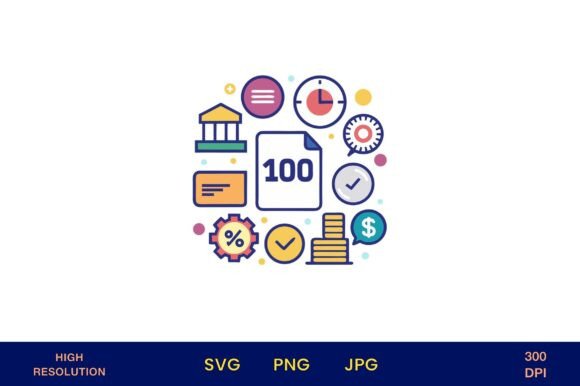
Icons Showing Success and Completion is a digital design resource centered on visual representations of achievement, progress, and full completion—most commonly expressed through a 100 percent concept. It includes a vector-based illustration composed of clean, scalable icons and supporting progress elements such as circular progress bars, checkmarks, ribbons, stars, or milestone markers. The design is delivered as a high-resolution PNG file with a transparent background (4500px × 4500px, 300 dpi), optimized for both digital and print use.
This type of asset serves creators who need consistent, professional-grade visuals to communicate accomplishment—whether in personal projects, small business branding, event planning, or client-facing materials. Unlike custom illustrations or stock photo collections, Icons Showing Success and Completion offers a focused, ready-to-use composition built around a single, cohesive theme.
Why Consider This Type of Design Asset?
People often seek Icons Showing Success and Completion when they need to reinforce positive outcomes visually—without relying on text-heavy explanations. Common motivations include:
- Adding clarity and emotional resonance to milestone announcements (e.g., graduation, project launch, fitness goals)
- Supporting event-related communications where tone and symbolism matter—such as wedding seating charts, “Save the Date” cards, or bridal shower decor
- Enhancing printable kits or planners where visual cues help users track progress or celebrate completed sections
- Creating branded merchandise (mugs, t-shirts, posters) that convey confidence, reliability, or celebration
- Strengthening social media posts or email campaigns tied to KPIs, campaign results, or customer success stories
The appeal lies in its specificity: it’s not a generic icon pack, nor a broad template. It’s a curated visual statement about reaching a goal—and that precision can save time during design development.
Benefits and Practical Advantages
The primary benefit is immediacy. With a transparent-background PNG at print-ready resolution, users avoid resizing, background removal, or color correction steps. The 300 dpi output ensures crisp results on physical prints—including invitations, stickers, or fabric transfers—while the large pixel dimensions allow cropping or partial use without quality loss.
Because it’s vector-derived (even though delivered as PNG), shapes and lines remain sharp at any scale within typical usage ranges. Designers working across platforms—Canva, Adobe Photoshop, Affinity Designer, or even PowerPoint—can place it directly into layouts without compatibility concerns.
Its versatility across contexts—from wedding menus to photographer branding or florist packaging—stems from neutral styling: minimal color variation, balanced composition, and absence of culturally specific symbols. That neutrality supports adaptation rather than limiting interpretation.
Tradeoffs and Realistic Expectations
As a single-file digital product, Icons Showing Success and Completion does not include editable source files (e.g., SVG or AI), layered PSDs, or alternate color versions. Users needing customization—such as changing icon colors, rearranging elements, or isolating individual components—will be limited to what raster editing allows. While the transparency enables layering, fine-tuning individual parts requires intermediate image-editing skills.
It also reflects one stylistic interpretation of success: clean, modern, and understated. Those seeking hand-drawn, retro, maximalist, or highly illustrated aesthetics may find it too restrained. Likewise, users requiring accessibility-compliant contrast ratios or multilingual text integration will need to add those elements separately.
Finally, because it’s a static composition—not an interactive or animated file—it doesn’t support dynamic data visualization. For dashboards or real-time progress tracking, this asset functions best as a decorative or symbolic overlay, not a functional component.
When This Asset Is a Strong Fit
Icons Showing Success and Completion works well for individuals or small teams managing multiple visual touchpoints with limited design resources. Examples include:
- A wedding planner assembling printable kits for clients and needing cohesive, celebratory visuals across seating charts, table numbers, and ceremony programs
- A photographer offering milestone packages (e.g., “First Year Baby Milestones”) and wanting a consistent emblem for digital galleries and printed albums
- A small business owner launching a service tier labeled “Complete Package” and needing a visual anchor for website banners, social posts, and thank-you cards
- A teacher or coach designing a habit-tracking printable where visual reinforcement of completion supports user motivation
In each case, the value comes from consistency and speed—not from technical complexity. If your workflow prioritizes reuse over iteration, this asset aligns efficiently.
When Alternatives May Be Worth Considering
Consider other options if you require:
- Editable flexibility: A vector-based icon set (SVG or EPS) with individual success-themed icons—checkmarks, trophies, medals, confetti—gives more control over layout, color, and scaling.
- Context-specific design: Custom illustration services or tailored Canva templates may better reflect brand voice, audience age group, or cultural nuance—especially for educational or nonprofit use cases.
- Functional interactivity: Web developers building progress dashboards or gamified learning tools will need JavaScript-driven solutions, not static imagery.
- Broad thematic coverage: Subscription-based design libraries (e.g., The Noun Project, Flaticon, or Creative Market bundles) offer wider variety across moods, styles, and use cases—but require curation and licensing review per item.
Making a Practical Decision
To determine whether Icons Showing Success and Completion suits your needs, ask three questions:
- Do I need a unified, precomposed visual for “100% achieved” across multiple deliverables? If yes, this asset reduces decision fatigue and ensures visual continuity.
- Will I use it primarily in static formats—printables, social graphics, merchandise—or in dynamic, editable environments? Its strength is in fixed applications; heavy editing or frequent reconfiguration reduces utility.
- Does my audience respond to minimalist, symbolic representation—or do they need narrative, contextual, or culturally grounded imagery? Simplicity aids recognition but may lack depth for complex messaging.
If two or more answers point toward consistency, static use, and symbolic clarity, this asset delivers practical value. If your priorities center on adaptability, storytelling, or technical integration, exploring modular or custom alternatives may better serve long-term goals.
Remember: no single design element replaces thoughtful communication. Icons Showing Success and Completion supports intent—it doesn’t define it. Use it where visual shorthand strengthens meaning, not where it substitutes for clear language or audience insight.