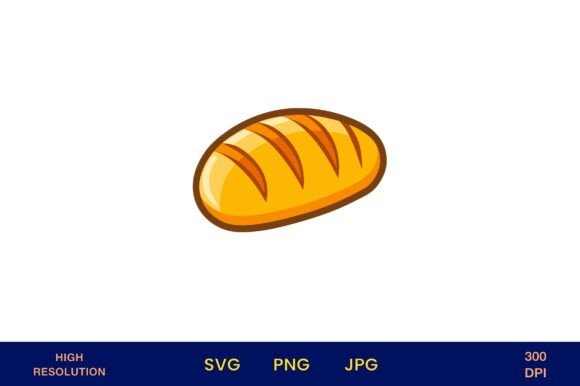
Bright Yellow Bread Loaf Icon Design
A Bright Yellow Bread Loaf Icon Design is more than a decorative asset—it’s a functional, high-fidelity vector illustration engineered for real-world creative and commercial use. Isolated on a clean white background with full transparency support, this golden, freshly baked bread loaf delivers visual warmth, authenticity, and immediate recognizability. At 4200px × 4200px and 300 dpi, it scales crisply across print and digital formats without loss of detail or color fidelity. You receive one cohesive design in three universal file types: PNG (with transparency), JPG (optimized for web sharing), and SVG (infinitely scalable for web development and cutting machines). This isn’t clipart—it’s precision-crafted vector art built to integrate seamlessly into professional workflows.
Where It Fits in Your Creative or Business Process
The Bright Yellow Bread Loaf Icon Design doesn’t sit in isolation. It enters your workflow at natural decision points—when you’re selecting visual assets for consistency, preparing branded collateral, or finalizing production-ready files for print or digital distribution. For example, if you’re designing a bakery’s social media calendar, this icon can anchor a series of posts about seasonal loaves, sourdough education, or behind-the-scenes baking moments. If you’re building a printable wedding suite for a rustic-chic couple, it adds subtle thematic cohesion to menus, seating charts, or escort cards—without competing with typography or photography.
It also supports upstream planning: before launching a product line (like artisanal baking kits or food-themed planners), using this icon in mood boards or client proposals signals tone, quality, and attention to detail. During execution, its transparent background eliminates time spent masking or editing layers in Photoshop or Canva. After delivery—whether to a client, printer, or end user—the SVG ensures crisp rendering on websites or mobile apps, while the high-res PNG and JPG meet strict print vendor requirements.
Compatibility Across Tools and Platforms
This design works where you work. In Adobe Illustrator or Affinity Designer, the SVG imports cleanly as editable vector paths—ideal for adjusting stroke weight, recoloring for brand alignment, or combining with other icons in a custom set. In Canva, Figma, or Google Slides, the PNG or JPG drops in instantly and resizes without pixelation. For crafters using Cricut Design Space or Silhouette Studio, the SVG enables precise cut lines for vinyl stickers, iron-on transfers, or custom tags. Even educators embedding visuals into lesson plans or bloggers optimizing Pinterest pins benefit from the 300 dpi resolution and warm, inviting color palette—no additional editing needed.
Importantly, the bright yellow tone is calibrated for accessibility: it meets contrast thresholds against white and light backgrounds while remaining visually distinct on darker UI elements when inverted or overlaid. That means it functions reliably—not just aesthetically—in mixed-media projects like hybrid event kits (digital invites + printed signage) or dual-format branding systems (web + storefront).
Practical Implementation Tips for Real Workflows
Start with intention, not decoration. Ask: “Does this icon serve a functional role—or just fill space?” Use it to reinforce meaning: as a bullet point marker in a step-by-step baking guide; as a section divider in a printable meal planner; or as a consistent motif across a florist’s seasonal packaging suite (e.g., pairing wheat stalks and bread icons for a harvest-themed collection).
Batch your usage for efficiency. If you’re producing multiple items—a set of bridal shower decorations, a series of recipe cards, or a small business’s holiday promo kit—apply the same icon consistently across formats. That builds recognition and reduces decision fatigue. Save variations (e.g., monochrome version for embroidery, outlined version for engraving) as separate layers or exports early—don’t wait until prepress.
Verify output settings before finalizing. While the file arrives print-ready, always check your export settings in your design tool: ensure “transparent background” is enabled for PNGs, “embed ICC profile” is selected for color accuracy, and SVGs are saved with “responsive” and “minified” options disabled if you plan further editing. For large-format prints (e.g., posters or banners), confirm your printer accepts native SVG or prefers flattened PDFs—and test a small proof first.
Long-Term Usability and Quality Control
Because this is a vector-based asset, it remains usable years later—even as software updates or project scopes evolve. Unlike raster-only files that degrade when upscaled, the SVG retains integrity whether used on a 2-inch sticker or a 48-inch trade show banner. That longevity supports sustainable design practices: fewer re-creations, less version sprawl, and consistent brand expression over time.
To maintain quality control across teams or collaborators, store the original files in a shared cloud folder with clear naming (e.g., BreadLoaf_Icon_BrightYellow_SVG_v1.svg) and a brief usage guide. Specify acceptable modifications—like recoloring within brand palettes—but discourage distortion, forced perspective, or low-res exports. When licensing or sharing internally, clarify that this is a single-user, royalty-free license for commercial use—no need to credit, but redistribution or resale of the file itself is prohibited.
Use Cases That Go Beyond Decoration
- Social media design: Use as a recurring visual anchor in Instagram carousels explaining fermentation timelines or Facebook Stories highlighting daily specials.
- Printable kits: Embed in editable PDF planners for bakers, food bloggers, or culinary educators—pair with checkboxes, ingredient lists, or oven-temp trackers.
- Merchandise production: Scale the SVG for screen printing on aprons or DTG printing on tote bags—its clean edges and minimal detail ensure sharp results even at small sizes.
- Branding systems: Combine with hand-lettered type or watercolor textures to build a cohesive identity for a micro-bakery, cooking class, or food podcast.
- Event coordination: Print on matte cardstock for table numbers at a wedding brunch, or layer onto kraft paper tags for gift baskets—its warmth complements natural materials.
Integrating Smoothly Into Your Routine
Think of the Bright Yellow Bread Loaf Icon Design as a utility—not a novelty. Keep it in your “go-to assets” folder alongside fonts, brand palettes, and standard templates. Tag it in your digital asset management system with keywords like bakery, food-icon, print-ready, and transparent-background so it surfaces during relevant searches. When onboarding a new client in the food or hospitality space, include it as part of your starter kit—alongside mood board examples and layout suggestions—to accelerate alignment.
If you're a freelancer or agency, bundle it thoughtfully: offer the icon as a value-add with logo design packages for bakeries, or include it in editable Canva templates for wedding stationery designers. For educators, embed it in downloadable classroom resources about nutrition, agriculture, or cultural food traditions—its clarity supports visual literacy without distraction.
Ultimately, this icon earns its place by solving small but frequent problems: saving time on asset prep, reinforcing thematic coherence, and delivering professional-grade output without requiring advanced technical skill. It’s ready when you are—no setup, no plugins, no learning curve. Just download, place, and proceed with confidence.